


The Daily Trust Foundation, on Monday, March 30, 2026, hosted a specialized webinar aimed at equipping Nigerian journalists with the skills to move beyond traditional news reporting into the realm of narrative journalism.
The virtual session, which drew 30 participants from various media houses across the country, focused on the power of “storytelling with a purpose.” The training sought to bridge the gap between dry, fact-based reporting and immersive, character-driven narratives that resonate more deeply with audiences.
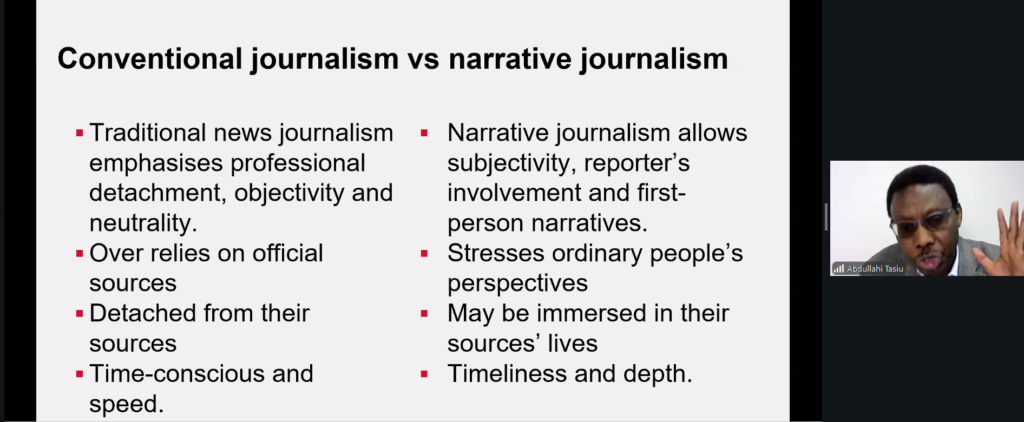
The facilitator for the session was Dr. Abdullahi Tasiu Abubakar, the Head of Postgraduate Studies at the Department of Communication, City St George’s, University of London. During his presentation, Dr. Abubakar meticulously broke down the distinctions between narrative journalism and conventional hard news.
“While traditional journalism focuses on the ‘inverted pyramid’—leading with the most crucial facts like who, what, where, and when—narrative journalism borrows techniques from creative writing,” Dr. Abubakar explained. “It uses scenes, character development, and a story arc to provide a more holistic view of human experiences while remaining strictly grounded in factual truth.”
The webinar highlighted that in an era of “information overload,” narrative journalism is essential for keeping audiences engaged. By focusing on the “why” and the “how” through the eyes of real people, journalists can humanize complex issues—such as migration, climate change, or economic policies—making them more relatable and impactful.
Dr. Abubakar noted that while the style is gaining traction in Nigeria, several international media organizations have built their reputations on this brand of long-form, immersive reporting. Notable examples include: The New Yorker (USA); The Guardian (UK – particularly its Long Read section); The New York Times (USA – famous for its Snow Fall multimedia narrative);; The Atlantic (USA); and Granta Magazine (UK)
Participants were informed of several key advantages of adopting this style:
- Increased Audience Retention: Readers are more likely to finish a story that feels like a narrative journey rather than a list of facts.
- Emotional Connection: It builds empathy by showing the human face behind the headlines.
- Longevity (Evergreen Content): Narrative stories often have a longer “shelf life” than daily news, as they provide deeper sociological and emotional insights that remain relevant for years.
- Platform for Complexity: It allows journalists the space to explain nuanced situations that cannot be simplified into a 300-word news brief.
The session concluded with a Q&A where journalists discussed the challenges of practicing narrative journalism when many journalists lack the skills involved in narrative writing and where the government is hostile to critical reporting. .
